
Why I folded my free tool into the agency site
Plugin Risk Score used to live at its own domain. It doesn’t any more — it sits on the Prystine site, under /tools, and the old domain redirects there.
That’s a small, unglamorous change. But the thinking behind it took me longer than it should have, so it’s worth writing down.
What the tool is
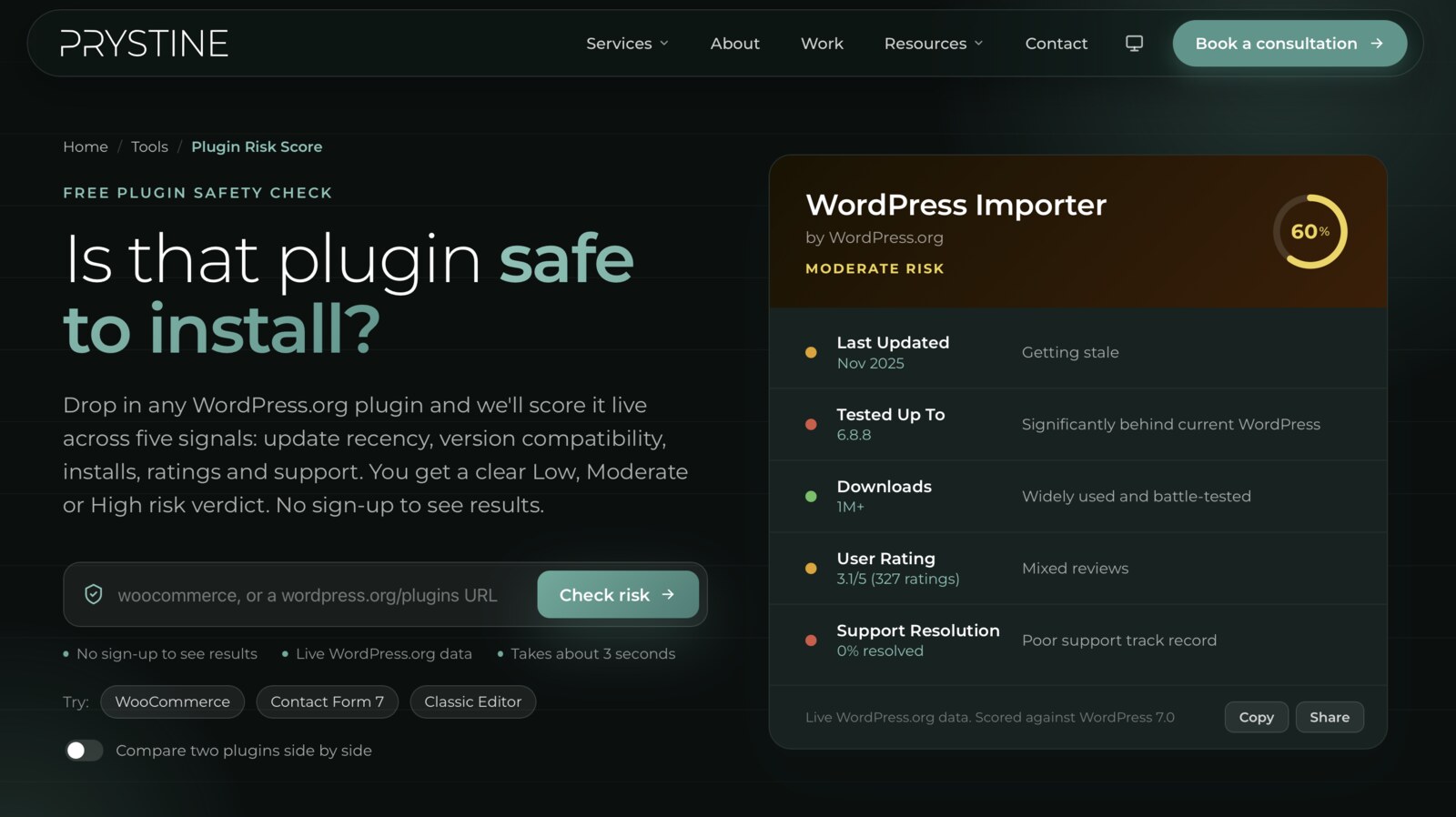
Plugin Risk Score answers one question: is this WordPress plugin safe to install?
Paste in a plugin and it scores five live signals from the WordPress.org API — when it was last updated, whether it’s compatible with current WordPress, how many active installs it has, its rating, and how much of its support queue actually gets resolved. Out comes Low, Moderate or High risk, in about three seconds. No account, no email, no upsell.
I built it because I install a lot of plugins for clients and I was doing those checks by hand, badly, every time.
Why it got its own domain
Because that’s what you do, isn’t it?
You build a thing, the thing feels like a product, products have domains. There’s a whole genre of advice pointing that way — indie hacker energy, ship a microsite, let it find its own audience. I bought the domain without really interrogating it.
And in fairness there was a reason: I liked the idea that it could grow into something. Its own brand, its own following, maybe its own business model later.
What actually happened
It worked fine. People used it. And it went nowhere in particular.
The problem wasn’t the tool — it was that the tool was a dead end. Someone would arrive, check a plugin, get their answer, and leave. That’s a successful visit, technically. It’s also the whole relationship.
Meanwhile, sitting on the other side of the internet, was a WordPress agency run by the person who built it. And the connection between those two things was: nothing. No path. Not even a sensible link, really.
Then I actually thought about who uses it.
Someone checking whether a WordPress plugin is safe to install is, definitionally, someone who runs a WordPress site and cares about not breaking it. That is my client profile. Not adjacent to it — precisely it.
I had built a tool that qualified people better than any advert I could buy, and pointed it at a domain that couldn’t do anything with them.
The distinction I was missing
Here’s the bit I’d been getting wrong, and it applies well beyond this one tool.
A free tool that demonstrates expertise is not a product. It’s marketing. Very good marketing — the useful kind, the kind that gives something away before it asks for anything — but marketing. And marketing belongs on the site that sells the thing it’s demonstrating.
A product is different. A product has a business model, users who come back, a reason to exist independently of who made it. Quotify and SendTidings are products. They have their own domains and they’ll keep them, because they stand on their own and eventually they’ll be things people choose rather than things people stumble across.
Plugin Risk Score was never going to be that, and pretending otherwise was costing me.
Once I put it that way the decision was obvious. Move it.
The other reasons, briefly
Two more practical arguments, both real but neither decisive on its own.
Search. A new domain starts from nothing. No history, no authority, no reason for anyone to trust it. The same tool on an established domain inherits everything that domain has already earned. I’d effectively been asking a brand-new site to compete on a topic where my actual site already had standing.
Maintenance. Another domain is another renewal, another certificate, another deploy target, another thing to remember when something changes. It sounds trivial and it is trivial, right up until you’ve got five of them and the small ones start quietly rotting. Small tools die of neglect more often than anything else.
Do it properly if you do it
One technical note, because getting this wrong throws away the thing you’re trying to keep.
Don’t switch the old domain off. Redirect it — a proper 301 from the old address to the new one, so anyone who linked to it still lands somewhere useful and search engines pass the credit along. Then keep paying for that domain. It’s a few quid a year to not break every link anyone ever made to your work.
Turning a domain off is the digital equivalent of moving house and not telling anyone.
Would I do it again
Yes, and sooner.
The version of this I’d tell someone else: before you buy a domain for the clever little thing you’ve built, ask whether it’s a product or a demonstration. Products earn their own home. Demonstrations should live where the work is.
For a while I ran a marketing asset as if it were a startup. It’s doing a better job now that it’s stopped pretending.